On June 4, 2026, the FCC circulated a draft rulemaking that would reach into nearly every corner of the E-Rate program at once. The document, Ensuring Children's Safe Use of Screens and E-Rate-Funded Services; Promoting Fair and Open Competitive Bidding in the E-Rate Program (FCC-CIRC2606-02), is a combined Notice of Proposed Rulemaking and Further Notice of Proposed Rulemaking set for the FCC's June 2026 Open Meeting under new WC Docket No. 26-133.
This guide breaks down all 42 proposals in plain English, and pairs each one with the complete, word-for-word text from the FCC draft so nothing is taken out of context. Where the draft uses a rule citation, § refers to a section of 47 CFR.
Nothing here is law, and nothing here is final. A draft rulemaking is the start of a conversation, not a decision. Think of it as the FCC opening the floor: the NPRM half asks questions ("we seek comment on whether…") and the FNPRM half formally proposes rule text, but every idea here can be narrowed, changed, or dropped before any rule is adopted, and many may never become rules at all. This is the beginning of the process, not the end of it. Comments are due 30 days after Federal Register publication, with reply comments 60 days after, filed in WC Docket Nos. 26-133, 13-184, 21-93, and 21-455 via ECFS.
This post summarizes and quotes the draft, but it is no substitute for the source. Before drawing conclusions or filing a comment, read the full FCC document: FCC-CIRC2606-02 (DOC-422168A1, ~70 pages).
As this moves forward, keep an eye on the advocacy groups already engaging with it. The SHLB Coalition, which advocates for schools, libraries, and broadband access, is expected to file formal comments and may host a webinar that digs deeper into what the proposal means for applicants. CoSN (the Consortium for School Networking), the professional association for K-12 education technology leaders, has also issued a statement on the review. Both are worth watching as the comment window opens. For early news coverage of the announcement, see GovTech's report.
The 60-second version
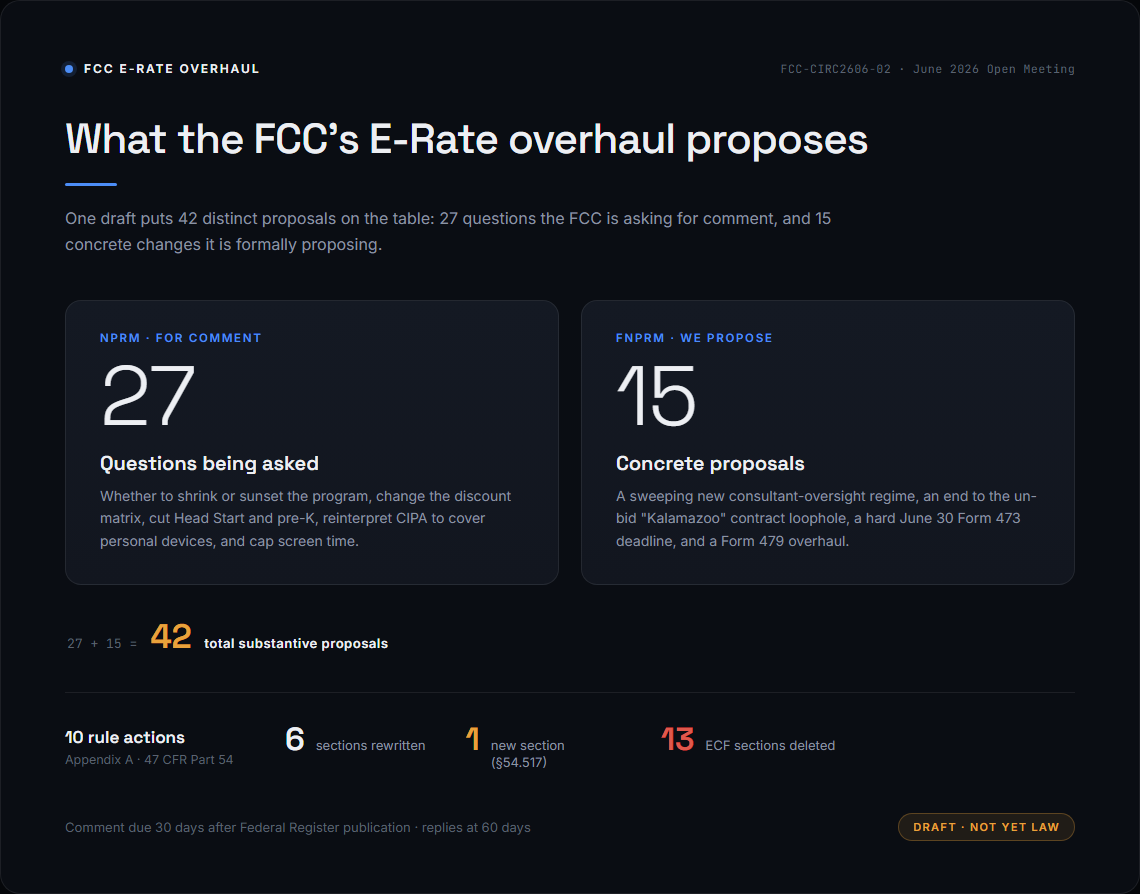
- 42 proposals total, 27 NPRM questions (ideas the FCC is asking about) and 15 FNPRM proposals (concrete changes with draft rule text).
- The program itself is on the table. The FCC asks whether E-Rate has met its mission and should be limited or sunset given near-universal connectivity.
- CIPA and screen time could expand to cover personal/BYOD devices, network-level filtering, and even per-day screen-time limits.
- Consultants are hit hardest, a brand-new registration regime, a new annual FCC Form 5654, personal IDs, a ban on percentage-based fees, and personal liability exposure.
- Procurement tightens, the un-bid "Kalamazoo" contract shortcut would end, and the June 30 Form 473 deadline (already used in practice) would become a rule.
The basics & glossary
A draft FCC rulemaking has two halves:
- NPRM (Notice of Proposed Rulemaking), the FCC asks questions. Ideas on the table, nothing decided.
- FNPRM (Further Notice of Proposed Rulemaking), the FCC formally proposes concrete changes, backed by draft rule text in Appendix A.
By the numbers: 42 proposals, 27 NPRM questions plus 15 FNPRM proposals, carried out through 10 rule actions in Appendix A (6 sections amended, 1 new section, 13 ECF sections deleted).
Glossary
- NPRM (Notice of Proposed Rulemaking)
- The stage where a federal agency publicly asks for input on changes it is considering. It poses questions ("we seek comment on whether…") and floats ideas, but does not decide anything or commit to specific rule text. Comments filed at this stage shape what the agency does next.
- FNPRM (Further Notice of Proposed Rulemaking)
- A follow-on stage where the agency moves past open questions and formally proposes specific rule changes, backed by draft regulatory text (here, in Appendix A), while still inviting public comment before anything is finalized. It is a firmer signal of intent than an NPRM, but still not a final rule.
- E-Rate
- Federal program giving schools and libraries 20%–90% discounts on internet, telecom, and internal network gear.
- USAC
- The administrator that runs E-Rate for the FCC ("the Administrator" in the rules).
- EPC
- E-Rate Productivity Center, USAC's online filing portal.
- CIPA
- Children's Internet Protection Act; requires content filtering plus an internet safety policy.
- Category One / Two
- Connectivity to a building / equipment inside a building.
- Form 470
- The form that opens competitive bidding. Posting it on USAC's website publicly describes the services or equipment you want bids on, and starts the mandatory 28-day waiting period (the Allowable Contract Date) before you may select a provider or sign a contract.
- Form 471
- The funding application itself, filed after bidding closes. It tells USAC which services you selected, from which service provider, at what cost, who the recipients are, and requests the discount, along with the program certifications you sign under penalty of law.
- Form 473 (SPAC)
- Service Provider Annual Certification; the yearly vendor rule-compliance form USAC needs on file to pay out.
- Form 479
- A consortium member's CIPA-compliance form to the consortium lead.
- Form 5654
- The new consultant certification form this draft would create.
- ACD
- Allowable Contract Date; the earliest you may sign a contract (28 days after posting the Form 470).
- CRN
- Consultant Registration Number (today firm-level; the draft makes it per-person).
- MIBS
- Managed Internal Broadband Services (paying a vendor to run your Wi-Fi).
- NSLP
- National School Lunch Program (poverty proxy that sets the discount percentage).
- ECF
- Emergency Connectivity Fund ($7.171B COVID-era program, sunset June 30, 2024).
- BEAD
- $42B federal broadband build-out program administered by NTIA.
The count
How we got here (neutral background)
The draft did not appear in a vacuum. Two threads run through it. First, a standing review of E-Rate's scope, cost, and integrity: near-universal connectivity after roughly 30 years (about 99% of schools report broadband), roughly $3B+ disbursed annually under a $5.2B cap, a 2020 GAO report on consultant-oversight gaps, the FCC's broader deregulatory initiative, overlap with BEAD, and the 2025 reversals of bus-Wi-Fi and hotspot funding. Second, a children's screen-time and online-safety focus drawn from a 2026 Surgeon General advisory and research the draft cites.
The proposal was previewed by two public officials on June 3, 2026, the day before the Fact Sheet. These are the speakers' own statements, not FCC findings. The binding text of what is actually proposed is in the sections below.
Over the last few years—and especially during COVID—schools dramatically increased screen time for students. But research is now pouring in showing that excessive screen time has been associated with poor academic performance, and we've seen a serious slide in reading and other basic skills along America's students. For its part, the FCC has been subsidizing connections to and within schools for three decades—spending roughly $3 billion annually today. It is time to review the FCC's program (known as E-Rate) to ensure great educational outcomes—not distractions or declining performance. So today, I have announced that the FCC will vote this month on a proposal to conduct a thorough review of the agency's program. This aligns with a broader trend we are seeing in states, in Congress, and across the Administration to empower parents and address excessive screen time.
Screen time in schools has surged in recent years—particularly during COVID. Parents often have little information or choice about their kids' online exposure during school hours. President Trump has been empowering parents and working for great educational opportunities for all. The FCC is doing its part by examining a $3 billion a year program that subsidizes connections to and within schools. We want to make sure this program supports good educational outcomes, not distractions or poor performance.
The statement was echoed by the NTIA, whose Assistant Secretary applauded the FCC's NPRM on children's screen use in schools.
Good policy occasionally takes the scenic route. @SenateCommerce Republicans have spent years examining E-Rate, from USF reform and hotspot expansion to initiatives like Eyes on the Board and KOSMA. Glad to see the @FCC undertake a comprehensive review of the program. Looking forward to the discussion.
Who it hits
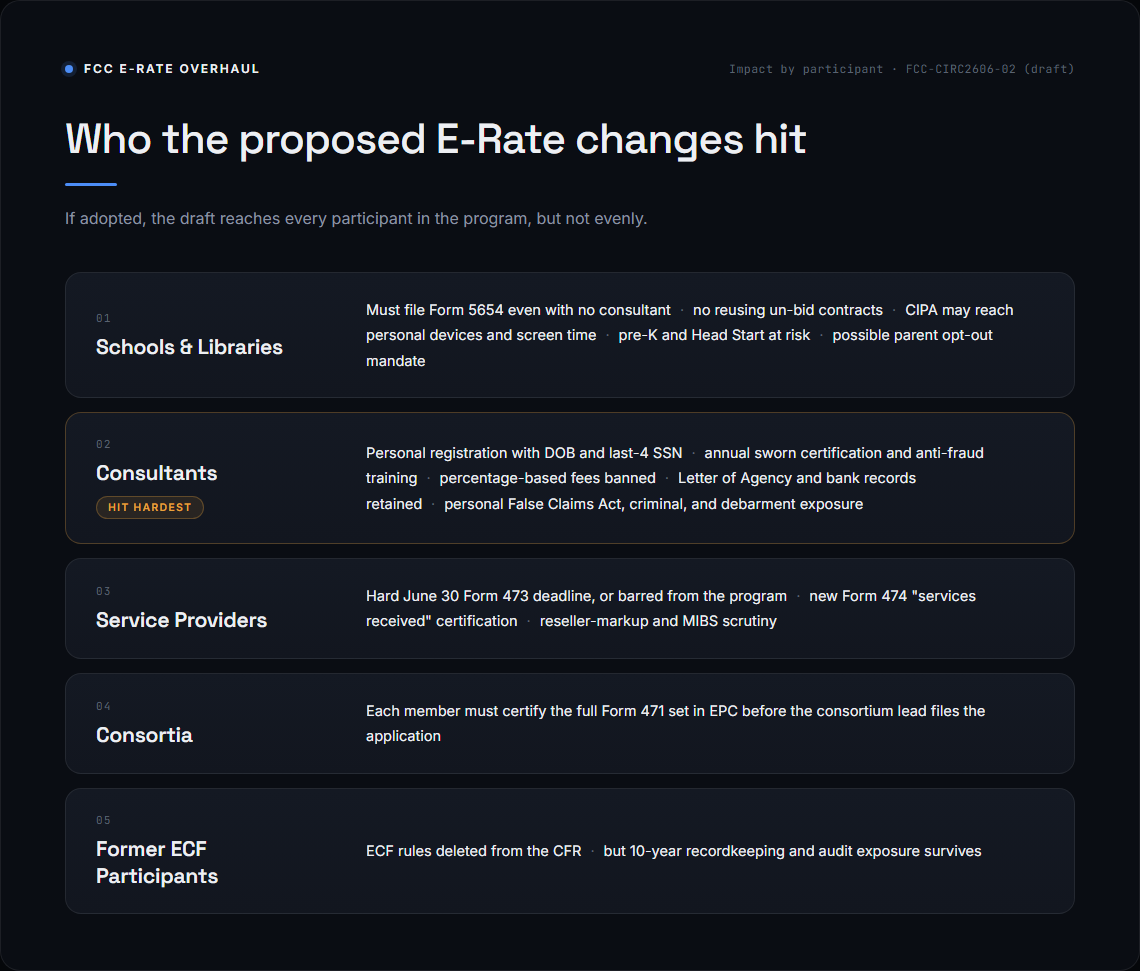
- Schools & libraries: must file Form 5654 even with no consultant (F2); can't reuse un-bid contracts (F10); CIPA may reach personal/BYOD devices and screen time (N15–N16); pre-K and Head Start at risk (N14); a possible parent opt-out mandate (N12); discounts may change (N8–N10).
- Consultants (hit hardest): personal registration with date of birth and last-4 SSN, consultants only, not E-Rate-wide (F6); a yearly sworn certification (F2); percentage-based fees banned (F8); annual anti-fraud training (F7); Letter of Agency and bank-record retention (F9); personal False Claims Act, criminal, and debarment exposure (F4).
- Service providers: the June 30 Form 473 deadline already used in practice would become a rule, with a possible program bar (F12); a new Form 474 "services received" certification (F14); reseller-markup and MIBS scrutiny (F15).
- Consortia: each member must certify the full Form 471 set in EPC before the lead files (F13).
- Former ECF participants: rules deleted, but 10-year recordkeeping and audit exposure survives (R10).
Part I: the NPRM: 27 questions the FCC is asking
Note the verbs: almost every paragraph says "we seek comment on whether." These are questions, not decisions.
A. Whether to shrink the program (paragraphs 12–19)
N1. Narrow, limit, or end the E-Rate program
In plain English: After roughly 30 years and near-universal connectivity, the FCC asks whether E-Rate has met its goal and whether it should be cut back or shut down.
As a threshold matter, Congress enacted the E-Rate program to ensure that schools and libraries across the country "have access to advanced telecommunications services." We are interested in understanding the E-Rate program's progress in achieving this purpose and to what extent the E-Rate program should be reexamined in light of the current state of school and library connectivity and current demand for program funds. When the E-Rate program was established pursuant to section 254(h) of the Communications Act, many schools and libraries lacked basic access to the Internet; today, however, some data sources state that virtually all schools report having broadband connectivity and Wi-Fi. In establishing the program in 1996, Congress was addressing a specific problem: limited access to advanced telecommunications and Internet services in schools and libraries. Given the substantial expansion of broadband access in schools and libraries over the last three decades, we seek comment on whether and to what extent the E-Rate program has fulfilled that mission and whether continued funding is consistent with Congress's original objective. Has Congress' directive in section 254(h) of the Communications Act been satisfied? Should the E-Rate program be limited or sunset to reflect today's extensive connectivity rates? At what point should policymakers conclude that the program's core objective has been achieved? We seek comment on whether Congress intended E-Rate to operate indefinitely, regardless of the extent to which schools and libraries have achieved universal connectivity. As the E-Rate program has worked to expand connectivity rates across schools and libraries, we note that demand for program funds has consistently fallen under the cap in recent years, while the program's annual funding cap has steadily increased to account for inflation each year consistent with the Commission's rules. The E-Rate program supports both Internet connectivity to and within schools and libraries, with applicants requesting $1.806 billion in funding year 2025 for category one services (i.e., connections to schools) and $1.418 billion in funding year 2025 for category two services (e.g., internal connections, Wi-Fi, basic maintenance, managed internal broadband services). Since funding year 2016, special construction has been eligible for E-Rate funding in limited circumstances—namely, when it is the most cost-effective solution for providing the requested broadband services. The E-Rate program has disbursed approximately $136.6 million to support self-provisioned network construction since the Commission added it as an eligible service to the E-Rate program in funding year 2016.
In recent years, the federal government has provided billions of dollars of investment in other programs for expanding broadband access, including for schools and libraries. Against this backdrop, we seek comment on whether the E-Rate program's current structure is consistent with the statutory directive or, as discussed below, whether the program should be limited or otherwise restructured to reflect today's connectivity rates, reduce federal spending, and ensure that E-Rate funds are not used to subsidize potentially duplicative services or services beyond those authorized or envisioned by Congress in the 1996 Telecommunications Act. To the extent commenters believe the program should be limited or restructured in this way, we invite them to address the Commission's legal authority under section 254 of the Communications Act to modify the program consistent with and mindful of the principles of fiscal responsibility and statutory limitations.
N2–N5. Roll back eligible services; disclose other funding; limit or eliminate special construction
In plain English: N2 asks whether any currently-eligible services should be reconsidered as no longer necessary or inconsistent with the statute (noting bus Wi-Fi and hotspots were already reversed in 2025); N3 whether to eliminate or limit special construction, self-provisioned networks, and dark fiber given BEAD; N4 whether to require applicants to disclose other funding sources to avoid duplication; N5 whether to limit special construction to single-provider areas.
We note that the scope of the services and equipment eligible for support within the E-Rate program has expanded significantly since its inception and evolved over time, and the program has been subject to recent criticism for such expansion. For example, in 2023 and 2024, respectively, the Commission expanded E-Rate support to include Wi-Fi on school buses and hotspots for schoolchildren—uses that are inconsistent with the statute and were reversed in 2025. We seek comment on whether similar expansions within the E-Rate program warrant reconsideration. Are there services that are currently eligible for support that are no longer necessary or are inconsistent with the statute? Specifically, are there any services or equipment that the program currently funds that do not ultimately transport information to school classrooms and, therefore, should be ineligible for E-Rate funding? In addition, we seek comment on whether the expansion of E-Rate support to include special construction adopted in the 2014 Second E-Rate Order remains justified in light of today's school connectivity rates and the availability of other federal funding sources. We note those changes were subject to significant legal and policy criticism at the time and have raised ongoing concerns about facilitating subsidized overbuilding and distorting competitive markets. Does continued support for self-provisioned network construction and dark fiber risk displacing private investment or wasting federal resources on duplicative infrastructure, particularly as programs such as the Broadband Equity, Access, and Deployment (BEAD) program administered by NTIA and established in 2021 are aimed at ensuring high-speed broadband availability in any remaining unserved and underserved areas, including for community anchor institutions? Should we require applicants and service providers to specifically disclose other funding sources to avoid duplication? Should funding for special construction be limited to those areas that are served by only one service provider? Should funding for special construction be eliminated entirely? We seek comment on these questions and whether BEAD and other similar sources of funding make it no longer necessary for the E-Rate program to continue to provide support for self-provisioned network construction, even in limited circumstances.
N6. Reverse the "on-campus activity is automatically educational" presumption
In plain English: Today, anything done on school or library property is presumed to serve an educational purpose (and is fundable). The FCC asks whether to flip that.
The Commission also previously established a legal presumption that activities that occur on library or school property serve an educational purpose and, therefore, are eligible for E-Rate funding. We seek comment on whether this presumption should be reversed.
N7. Safeguards against vendor/consultant influence over purchases
In plain English: Asks whether current program rules create incentives for vendors or consultants to promote particular technologies without corresponding improvements in educational outcomes, and what additional safeguards the Commission should consider.
We also seek comment on the role and incentives of communications and educational technology vendors in the evolution and operation of the E-Rate program. We recognize that E-Rate-funded services are used within broader school and library technology ecosystems that may include non-E-Rate-funded equipment, devices, and services, including end-user devices, educational applications, and content that are offered by educational technology vendors, not typically provided by E-Rate service providers. We seek comment on whether, and to what extent, the expansions and changes in the scope of the eligible services funded by the program and discussed above have been driven or influenced by vendor interests rather than the educational purpose requirement of the Communications Act. We also seek comment on the role of E-Rate funding within these technology ecosystems, and the degree of influence consultants and vendors may have on the services and equipment (both E-Rate eligible and non-E-Rate eligible) selected by schools and libraries. Specifically, do current program rules create incentives for vendors to promote particular technologies or deployment models that may increase reliance on subsidized services without corresponding improvements in educational outcomes? As discussed below, we propose specific actions to strengthen oversight over consultants. Are there additional safeguards we should consider to limit undue vendor influence in procurement, and to better align the program with the interests of students and library patrons, rather than the commercial incentives of vendors and/or consultants?
N8–N9. Rethink the discount matrix; phase out the wealthiest areas
In plain English: Discount rates (20% to 90%) are set by poverty (NSLP participation) and urban/rural status. N8 asks whether that method still allocates funds fairly and efficiently, or whether a disproportionate share flows to large, well-resourced districts, and whether the rates should be adjusted. N9 asks whether to phase out funding for areas with the lowest NSLP participation rates, given their likely greater resources and tax bases.
Since its inception, the E-Rate program has provided eligible schools and libraries discounts on the cost of eligible services ranging from 20% to 90%, with higher discounts provided to the most disadvantaged schools and libraries. We seek comment on whether the use of the National School Lunch Program (NSLP) eligibility and urban/rural status in determining an applicant's discount rate remains an effective method for calculating support and ensuring that we are satisfying the universal service principles established by Congress in section 254 of the Communications Act. Does this general approach allocate funds fairly, efficiently, and achieve the objective of helping low-income and rural schools, or does a disproportionate share of funding flow to large, well-resourced school districts with substantial local tax bases? Additionally, we seek comment on whether adjustments to the current discount rate system could better allocate the limited E-Rate funding. If so, what adjustments would be appropriate? Should the discount rate for rural schools and libraries be higher than the discount rate for urban schools and libraries? When the Commission created the E-Rate program, it recognized that schools and libraries in rural areas would likely face higher costs for E-Rate supported services. The Commission has accounted for these additional costs by providing rural schools and libraries with higher discounts than their urban counterparts in the same discount tier. However, we now seek comment on whether to modify the discount rates in order to ensure applicants are incentivized to select the most cost-effective offerings to meet their needs. In making any such changes, we seek to ensure fiscal responsibility and maximize the efficiency of the program. We further seek comment on whether to phase out E-Rate funding for schools and libraries in areas with the lowest NSLP participation rates, given the likelihood of greater resources and tax bases.
N10. Limit support to highest-cost / rural / single-provider areas
Relatedly, we note that although broadband prices have generally been decreasing, they are demonstrably higher in less competitive areas and those that lack competition entirely. Given increases in competition that may result from increased deployment by providers and federal funding programs, we seek comment on whether E-Rate support should be limited to areas where applicants face the highest costs for E-Rate supported services. For example, should E-Rate support be limited to rural areas or to areas served by a single provider? What would be the benefits and costs of such an approach?
Context: paragraph 19: evidence on educational outcomes
In addition, we seek comment on the extent to which the E-Rate program has influenced educational practices and outcomes. Although neither Congress nor the Commission have established principles or specific goals for educational outcomes, we are interested in information regarding the impact of the E-Rate program on school technology choices. In particular, is there evidence that schools or districts receiving higher levels of E-Rate funding—especially those qualifying for the highest discount rates—have greater reliance on 1:1 device initiatives, digital curricula, or other forms of screen-based instruction? Are higher levels of E-Rate support associated with improved educational outcomes, no measurable effect, or, conversely, poorer impacts on student achievement, literacy, and numeracy? Commenters are encouraged to provide empirical data, studies, or other evidence analyzing correlations or causation between E-Rate funding levels, instructional practices, and student outcomes, and to address how any such findings should inform the Commission's evaluation of the program's effectiveness and alignment with its statutory objectives.
B. Children's safety & "educational purposes" (paragraphs 20–23)
N11. Tighten "educational purposes" to police screen time
E-Rate applicants are required to certify that the services requested through the E-Rate program will be used primarily for educational purposes. Like all of the applicants' other certification requirements, this certification is intended to encourage accountability on the part of schools and libraries. As schools and libraries integrate digital media into their curricula and catalogs, we seek comment on how to ensure that E-Rate-funded networks and services are being used for "educational purposes." As noted herein, children's screen time often exceeds the recommendations of experts and can include access to content that is not "integral, immediate, and proximate" to the education of students or the provision of library services. For example, some suggest that screen time may be used in the classroom to calm or reward students. Should these uses be considered "educational purposes" as contemplated by the Communications Act? How can E-Rate applicants ensure that use of E-Rate-funded networks is for an "educational purpose," as contemplated by the statute? We also seek input about the measures schools and libraries are taking to limit screen time. What have been the costs of implementing existing measures to limit screen time and how are these costs likely to change with wider implementation? How should the Commission quantify the benefits of limiting screen time for children? In addition, we seek comment on whether there are differences between what qualifies as an educational purpose for a school versus a library.
N12. Require schools to let parents opt their kids out of screen use
In recent years, a growing number of parents across diverse school districts have sought the ability to opt their children out of routine or sustained screen-based instruction, reflecting concerns about excessive screen use, impacts on learning outcomes, and student well-being. In light of these developments, we seek comment on whether, and to what extent, we should require, as a condition of receiving E-Rate support, that participating schools provide parents with a meaningful opportunity to opt their children out of screen-based instruction or screen use during the school day. The Commission also seeks comment on whether it has the legal authority under section 254 of the Communications Act or any other provision of law to adopt such a requirement, including any relevant limitations on conditioning E-Rate funding, and how such a requirement could be structured.
N13. Require adult supervision and/or content-reporting tools
Recent guidance suggests that limiting screen time alone may be insufficient to prevent potential harm to children online. Are there other actions the Commission can take instead of, or in addition to, limiting screen time to better protect the online safety of children when using E-Rate-funded networks and services to ensure they are being used for an educational purpose? For example, should adult supervision be required, and how would schools implement such a policy given the "always on" nature of modern Wi-Fi networks? Should schools and libraries be required to implement methods for school- or library-staff, parents, guardians, and children to report inappropriate content to the school or library when using E-Rate-funded networks and services? Should these supervision and reporting requirements differ for schools versus libraries; if so, what is the Commission's authority to implement and enforce separate requirements for schools and libraries? Should these supervision and reporting requirements apply whenever E-Rate-funded networks and services are being used, and apply as a condition of schools and libraries receiving E-Rate funding for which they must submit certifications? What is the Commission's authority to implement and enforce these types of supervision and reporting requirements?
N14. Remove or restrict Head Start & pre-K students
We seek comment on whether Head Start and pre-kindergarten students should continue to receive E-Rate program support and whether schools should be required to cost-allocate and remove Head Start and pre-kindergarten students from their funding requests. At present, eligibility of Head Start and pre-kindergarten facilities and students varies based on state law. Currently, 29 states and territories include Head Start facilities and students and 34 states and territories include pre-kindergarten facilities and students in their definition of elementary education and elementary schools. In E-Rate funding year (FY) 2025, approximately $15.5 million was committed to Head Start facilities and students, $7.4 million of which has been disbursed to date. Also in FY 2025, $43.9 million was committed to pre-kindergarten facilities and students, $21.6 million of which has been disbursed to date. We seek comment on whether reducing support would be reasonable if the benefits to such students of limited access are low, and the possibilities of harm are high. Since experts recommend that children under the age of five should limit Internet access to one hour per day or less, and are harmed if exposed to longer periods of use, should schools that include Head Start and pre-kindergarten students and classrooms be required to cost-allocate and remove these students and classrooms from their E-Rate funding requests? Would limiting the eligibility of Head Start and pre-kindergarten facilities and students within the E-Rate program further protect young children? Should the cost-allocation for Head Start and pre-kindergarten facilities and students be limited to Internet access services or include all E-Rate eligible services? Alternatively, we seek comment on limiting the eligibility of Head Start and pre-kindergarten facilities and students to those that are part of a public school or public school district. First, we understand that many non-public entities that serve Head Start and pre-kindergarten students are not subject to state or local procurement requirements, which are required for public schools that serve these students. Second, we also believe that, based on past experience, such a limitation would help prevent waste, fraud, and abuse in the program. For example, one daycare center in New York serving children ages two to four years old received $500,000 between FY 2009 and FY 2015 for services, including video conferencing and distance learning, that may not have served an educational purpose consistent with the Communications Act given the age of the children. If eligibility were limited to public school district entities, the New York daycare center would have been ineligible to receive E-Rate program funding. We note that several states and territories, including America Samoa, Illinois, Kansas, Louisiana, Missouri, Montana, Pennsylvania, South Dakota, Texas, and the U.S. Virgin Islands, already limit the eligibility of pre-kindergarten and Head Start students and facilities to those that are part of a public school or public school district. Would limiting the eligibility of pre-kindergarten and Head Start students to those that are part of a public school or public school district help address waste, fraud, and abuse in the program? Are there other ways to ensure E-Rate-funded networks and services accessed by pre-kindergarten and Head Start students are being appropriately used for educational purposes?
C. Re-examining CIPA (paragraphs 24–37)
Context: paragraph 24: the CIPA question framed
Congress enacted CIPA to protect children from exposure to harmful material while they are at a school or library and accessing E-Rate-funded Internet. CIPA requires schools and libraries "having computers with Internet access" to certify that they are enforcing an Internet safety policy that includes the operation of a "technology protection measure" (e.g., a filter) with respect to any of "its computers" with Internet access and addresses certain Internet safety and education requirements for minors. To ensure there is input from the local communities, including interested parents, guardians, and teachers, schools and libraries are also required to provide reasonable public notice and hold a public hearing or meeting to address the proposed Internet safety policy. In view of the wider range of Internet-enabled devices made available to children today and the importance of ensuring that E-Rate-funded networks and services remain safe for use by children, we seek comment on whether our current interpretation of CIPA is the best reading of the statute. We also seek comment on what other steps the Commission can take in these device-accessible environments to help prevent exposure to obscene material, child pornography, or other material deemed inappropriate or harmful for minors while accessing E-Rate-funded networks and services from a school or library receiving support for Internet access, Internet service, or internal connections, consistent with the language and purpose of CIPA.
N15. Extend CIPA filtering from school-owned computers to the whole network (incl. personal devices)
In plain English: Today CIPA covers only "its computers" (school/library-owned). paragraph 25 explores the owned-only reading; paragraph 26 explores the broader reading, covering any device that connects through the E-Rate network, including personal/BYOD devices.
The Commission currently interprets CIPA restrictions to apply only to the use of devices that are owned by schools or libraries (i.e., "its computers") receiving E-Rate support for Internet access, Internet service, or internal connections. The Commission has previously sought comment on applying CIPA requirements at the network-level and/or to third-party-owned devices that connect to E-Rate supported service in certain contexts. We seek comment on whether the phrases "having computers with Internet access" and "with respect to any of its computers with Internet access" and other similar language in the statute means that schools and libraries are required to comply with CIPA only with regard to those computers that they own or control. Does this interpretation fulfill the intended purpose of CIPA and is it consistent with the plain meaning of the statute? When CIPA was enacted in 2000, it was not common for third-party, Internet-capable devices to be brought into schools or libraries, and school- and library-owned devices were the default. Today, while many schools employ a 1:1 program to provide a device to each student, some schools permit third-party owned devices to connect to their networks and Internet. We seek comment on whether the text of the statute should be interpreted to mean that the level of protection provided to minors pursuant to CIPA differs depending on who owns the connecting device. Did Congress intend an arrangement under which a school- or library-provided device must protect minors but a third-party device connected to the same E-Rate supported network need not protect minors? Are the parents or guardians of children responsible for ensuring their third-party owned devices are protected when accessing the school's or library's network and services? Should schools or libraries prevent third-party owned devices from connecting to E-Rate-funded networks and services altogether? Should schools and libraries be evaluated differently on these questions based on the different populations they serve, or based on other criteria? Do schools and libraries have the technical capability to distinguish whether it is a school- or library-owned computer or a third-party owned device that is trying to connect to their networks? Do they have the technical capability to distinguish whether the user of a third-party device is an adult or a minor? What are those technical capabilities and how costly are they? Are those technical capabilities already eligible for funding through the E-Rate program or would they impose an additional cost on schools and libraries? What share of schools and libraries already impose restrictions on third-party devices? We seek to understand how schools and libraries would identify and prevent third-party owned devices from connecting to their networks and Internet access services and what the associated costs would be.
In the alternative, we seek comment on whether CIPA's references to schools and libraries "with computers having Internet access" or "any of its computers with Internet access" should be interpreted more broadly to be focused on protecting children from harmful online content on any computer accessing the Internet through a school or library if the school or library receives E-Rate support for Internet access, Internet services, or internal connections. If interpreted more broadly, should the Commission require compliance with respect to any device that is accessing the Internet through the school or library if the school or library receives E-Rate support for Internet access, Internet services, or internal connections, regardless of the ownership, or control of the device used to access the Internet? If so, how could schools and libraries comply with such an obligation with respect to devices that are not controlled by the institution? We also seek comment on whether we should amend the Commission's CIPA-related rules to reflect this reading of the statute, and if so, how we should amend them.
N16. Require network-level filtering; possibly include screen-time limits
Relatedly, we seek comment on whether technology protection measures should be required to include filtering at the network level (i.e., applying the filter to any device that connects to the network) to ensure all devices that are used by minors and connect to E-Rate-funded networks are protected from content that is obscene, child pornography, or harmful to minors. Should such filtering include limits on screen time? As some recent studies suggest that excessive screen time can have a negative impact on children, we seek input on whether the filtering mechanisms employed by schools or libraries currently include features for limiting screen time, who determines the screen time limits, and the extent to which such features are currently used.
N17. Define "monitoring the online activities of minors" and "unauthorized access"
In response to Congress enacting CIPA, the Commission amended the E-Rate program rules in 2001 to adopt CIPA requirements, as set forth in section 54.520 of the Commission's rules. In 2011, the Commission updated section 54.520(a) of its rules to codify numerous statutory definitions adopted from the 2008 Protecting Children in the 21st Century Act, including the terms "minor," "obscene," "child pornography," "harmful to minors," "sexual act," "sexual contact," and "technology protection measure." Since then, stakeholders have requested further guidance on the meaning of certain terms within CIPA. For example, in 2022, the Center for Democracy & Technology requested that the Commission clarify a school's requirement to enforce an Internet safety policy that includes "monitoring the online activities of minors." We seek comment on the meaning of "monitoring the online activities of minors" and how such monitoring should be used to advance the educational purposes of the E-Rate program. In their response, commenters should address any potential privacy concerns associated with monitoring the online activities of minors. Additionally, under section 254(l)(1)(iii) of the Communications Act, Internet safety policies must address "unauthorized access, including so-called `hacking', and other unlawful activities by minors online." We seek comment on the meaning of "unauthorized access" and whether it encompasses any material devoid of "educational purposes" (e.g., students scrolling through social media instead of doing online research) for E-Rate per section 254(h)(1)(B) of the Communications Act. For example, could "unauthorized access" mean that the student accessed a computer in excess of an Internet safety policy's prescribed number of hours? Should the term "computer" be defined? Are there other provisions of CIPA that should be defined?
N18. Revisit the 2011 finding that social media isn't per se "harmful to minors"
CIPA defines "harmful to minors" to mean: any picture, image, graphic image file, or other visual depiction that—(i) taken as a whole and with respect to minors, appeals to a prurient interest in nudity, sex, or excretion; (ii) depicts, describes, or represents, in a patently offensive way with respect to what is suitable for minors, an actual or simulated sexual act or sexual contact, actual or simulated normal or perverted sexual acts, or a lewd exhibition of the genitals; and (iii) taken as a whole, lacks serious literary, artistic, political, or scientific value as to minors. The Commission previously determined in 2011 that social networking websites are not per se "harmful to minors" under CIPA. Recognizing the statute's emphasis on leaving the determination of what online content is inappropriate for minors to local school and library authorities, and acknowledging that declaring such networking sites to be categorically harmful to minors would be inconsistent with the Protecting Children in the 21st Century Act's focus on "educating minors about appropriate online behavior," the Commission concluded that CIPA does not require schools and libraries to block such sites in order to receive E-Rate funding. In light of changes to the social media landscape since 2011 and more recent research on the impact of social media on children, should the Commission revisit that conclusion?
N19. Define "appropriate online behavior" education; possibly mandate digital-literacy courses
The Protecting Children in the 21st Century Act also revised CIPA to require each elementary and secondary school to certify that, "as part of its Internet safety policy, [it] is educating minors about appropriate online behavior, including interacting with other individuals on social networking websites and in chat rooms and cyberbullying awareness and response." We seek comment on whether the Commission should define what is required of schools in implementing this requirement to educate minors about "appropriate online behavior." Should such education include learning about how and why to limit one's own screen time? Studies suggest that expanding children's digital literacy requirements helps students navigate the Internet responsibly. However, digital literacy training need not be screen-based and may be more effective when taught in an analog environment. Would requiring minors to complete mandated digital and online media literacy courses potentially help reduce screen time and increase online safety for minors when using E-Rate-funded networks and services? If so, should minors be required to complete those courses prior to or simultaneously with the use of E-Rate-funded networks and services? How often should the courses be required? Who should be in charge of establishing the requirements for and content of such courses? Should the Commission, or the school board, local educational agency, library, or other agency be responsible for determining "appropriate online behavior" for the purposes of this education requirement? Should the content of the courses be structured to be age-specific? Should schools be required to produce documentation to the FCC demonstrating that children and minor students attended and completed the courses? If schools are required to produce such documentation, should the documentation be anonymized or reported based on the percentage of students who attended or completed the courses to protect any personally identifiable or sensitive information pertaining to minors?
N20. Adopt a "child" definition / age-tiered CIPA protections
Alternatively, should we consider refining any of the existing definitions in section 54.520(a) of the Commission's rules? For example, we currently define "minor" as any individual under the age of 17. We seek comment on whether we should also adopt a definition for "child" or use the COPPA definition of any individual under the age of 13 so that potential CIPA protections and requirements could be implemented based on the age of the child or minor impacted. Should the level of CIPA protection provided differ depending on the age or age ranges of a child or minor? Should there be heightened online safety requirements for younger children? If the Commission were to adopt rules for how children of different ages should or could be treated for the purposes of CIPA, are there any implementation challenges in defining differing age requirements? Should there be different requirements for schools versus libraries?
N21. Treat excessive screen time itself as "inappropriate for minors"
Given that under section 254(l) of the Communications Act, the school board, local educational agency, library, or other authority is responsible for determining what content is "inappropriate for minors," we seek comment on whether additional protections are permitted under CIPA, such as limiting screen time. Are schools and libraries currently assessing student screen time on devices? If so, how are schools and libraries assessing screen time? Have schools and libraries that currently are assessing screen time found any benefits or harms that would inform the Commission's policy? What filtering options are available to restrict screen time to only approved educational activities? What are the costs associated with applying any filtering options that limit screen time? Is it more important to limit the amount of screen time or limit the content available to ensure that E-Rate-funded services are used for educational purposes? Should screen time limits be different for schools and libraries? Would schools and libraries need to purchase additional software or have additional network support to implement screen time restrictions? What obligations could be imposed on schools and libraries under CIPA with respect to assessing screen time that uses E-Rate-funded networks and services? We also seek comment on whether excessive screen time or other aspects of Internet use not tied to specific content access limitations, could be considered "inappropriate for minors" under CIPA, consistent with the statute and the First Amendment. Are local authorities making informed, affirmative decisions regarding what is inappropriate for minors? We seek comment on whether parents and guardians have any input in determining what is inappropriate for minors. Without establishing any criteria for or reviewing the determination of what is inappropriate for minors, is there a role for the Commission in providing guidance to schools and libraries, given its role in setting policy for the E-Rate program?
N22. Prescribe minimum internet-safety-policy contents; collect and maybe publish them
CIPA requires schools and libraries receiving E-Rate supported services to adopt and implement an Internet safety policy that addresses certain requirements laid out in section 254(h) and (l) of the Communications Act and make such policies available to the Commission, upon request. We seek comment on what information and components an Internet safety policy should contain in order to comply with CIPA. Is there any minimum or mandatory information that an Internet safety policy should include? Under CIPA, does the Commission have the authority to invalidate or require the replacement of an Internet safety policy or is that authority reserved for the school board, local educational agency, library, or other authority under section 254(l) of the Communications Act? We also seek comment on whether the Commission should collect and retain each school's and library's Internet safety policy. If we collect them, should these policies be made publicly available? Do the requirements set out in section 254(h)(5)(A)(iii) and (6)(A)(iii) of the Communications Act to provide public notice and hold a public hearing or meeting require that these Internet safety policies be made public in some form? Will making the policies publicly available better inform the local communities, and the parents and guardians impacted by them? Will making the policies publicly available incentivize more or better participation in their construction by local communities, and the parents and guardians impacted by them? Should the final policies be able to be reviewed after adoption? If the policies are reviewed, how and by whom should they be reviewed?
Many schools and libraries model their Internet safety policies after or rely entirely on template policies created by other stakeholders. We seek comment on the adequacy of these frequently used template policies, and whether they meet the minimum bar for the statutory requirements of CIPA. Do they meaningfully address the requirements laid out in section 254(l)(1) of the Communications Act or actually engage local communities in the adoption and implementation of such policies? We also understand that schools and libraries may have separate policies concerning Internet access and the acceptable use of the Internet. How do these policies differ from the required Internet safety policies? Have schools and libraries that have expanded Internet safety policies found any benefits? Have expanded Internet safety policies imposed additional costs on schools and libraries? Should the Commission expand the requirements for Internet safety policies to include additional content from these Internet access and/or acceptable use policies? Do the schools' and libraries' Internet safety policies and acceptable use policies contain any confidential, sensitive, or personally identifiable information? Are schools and libraries already making their Internet safety and acceptable use policies publicly available? For those schools and libraries that make them publicly available, where are the policies being made publicly available (e.g., school or library website)? If there is confidential, sensitive, or personally identifiable information in the schools' or libraries' Internet safety policies, how are the schools and libraries protecting or withholding that information before making the policies public?
N23. Add timing/enforcement rules for the CIPA public notice & hearing
In establishing an Internet safety policy, schools and libraries are required to provide reasonable public notice and hold at least one public hearing or meeting to address the proposed Internet safety policy. These steps are critical for ensuring that local communities, including parents and guardians of the children within those communities, have an opportunity to weigh in on the Internet safety decisions being made for their children. We seek input on whether school boards, local educational agencies, libraries, or other local authorities are holding public hearings or meetings or providing reasonable public notice prior to adopting their Internet safety policies. We also seek comment on what constitutes "reasonable" public notice. Should we adopt a timing requirement to ensure that school boards, local educational agencies, libraries, or other local authorities provide the required public notice and hold the required public hearing or meeting sufficiently in advance of adopting their Internet safety policies to allow for participation in the process by parents and guardians? How would we implement and enforce such a requirement? How are schools and libraries providing public notice? How are parents and guardians provided notice? How far in advance of adopting an Internet safety policy should a school or library be required to provide public notice and hold a public hearing or meeting? Recognizing the importance of the public notice and public hearing or meeting requirements, we seek comment on whether there are additional steps the Commission can take to emphasize or enforce these requirements to ensure parents and guardians are being consulted on what their children are accessing through the school's or library's E-Rate-funded network and services. Should the Commission provide guidance on acceptable ways of posting the policies to the public?
N24. Tighten penalties/cure for skipping the CIPA public notice or hearing
In certain circumstances, such as failing to provide public notice or hold a public hearing or meeting, E-Rate applicants are given the opportunity to correct minor errors that could result in violations of the CIPA rules before a reduction or recovery of funding is instituted. Should the Commission direct USAC to reduce funding commitments or recover disbursed funding if it determines that the applicant failed to provide the required public notice and/or hold a public hearing or meeting? Should the applicant be at risk of having their funding denied and having to repay funding for the entire period of time that they were out-of-compliance with the CIPA requirements? Are there any circumstances under which a school or library should be allowed to cure a CIPA-related violation?
N25. Require additional/recurring public hearings
While CIPA requires schools and libraries to hold "at least one" public hearing or meeting, should the Commission require additional public meetings or hearings? For example, should schools or libraries be required to provide public notice and hold a public hearing or meeting each time the Internet safety policy is amended? What would be the costs and benefits of these additional meetings? Should there be an exception for de minimis changes to the Internet safety policy? We seek input on whether school boards, local educational agencies, libraries, or other authorities review and approve the Internet safety policy each time changes are made. Alternatively, does the statute permit requiring public notice and public hearings or meetings on an annual basis (e.g., before each school year) or some other time period? If additional public notice and public hearings or meetings are permitted or required, should the rules differ with respect to schools versus libraries? At a minimum, CIPA requires schools and libraries to keep at least some record of the public notice that was disclosed when the public hearing or meeting took place (e.g., a copy of the meeting agenda, or a newspaper article announcing the hearing or meeting). Should the Commission prescribe how the public notice should be released to ensure it is reaching the local community, including parents and guardians?
D. Authority beyond CIPA / screen-time limits (paragraphs 38–42)
N26. Whether the FCC has authority OUTSIDE CIPA to limit screen time (incl. per-day hour caps)
In plain English: paragraphs 38–41 ask, repeatedly, whether the FCC has any legal authority beyond CIPA to limit children's screen time on E-Rate networks, including hard per-day hour caps, and how that would be enforced.
As recent studies suggest that excessive screen time may negatively affect children and minors, does the Commission have any statutory obligation beyond CIPA or responsibility as a good steward of the limited E-Rate funds to assess how E-Rate-funded networks and services may be contributing to these potentially detrimental effects on children and minors? What statutory authority does the Commission have beyond CIPA to limit screen time or otherwise protect children and minors and empower greater parental control over their children's screen use when accessing E-Rate-funded networks and services? Is that statutory authority limited to E-Rate-funded networks and services, which are limited to the physical classroom or library building? Is that statutory authority different for schools than for libraries? Is that statutory authority limited to school- and library-owned computers and devices using E-Rate-funded networks or Internet access services?
As previously discussed in the context of CIPA, experts have recommended limits on screen time for children and minors based on age. Should screen time limits be based on the age of the children or minors? What should those limits be? Does the Commission have any statutory authority outside of CIPA to require such limits? What is the specific statutory basis for that authority? How would such limits be enforced at a school or library?
Some experts have differentiated between screen time associated with educational use (i.e., screen time used to enhance teaching and learning) and recreational screen time (e.g., non-educational screen time used to watch TV, play video games, engage with social media apps, browse the Internet for leisure, or text or scroll through photos on a smart phone). Are there distinctions between educational screen time and recreational screen time when it comes to children and minors using E-Rate-funded networks? Do the distinctions differ depending on whether an E-Rate-funded network is being accessed using a school- or library-owned computer or a third-party-owned device? In practice, are children and minors able to access both educational and recreational platforms using E-Rate-funded networks and services? If they are able to access both, could the recreational use be decreased or prevented by implementing modified or stricter blocking and filtering requirements? Is there statutory authority outside of CIPA that we could use to decrease or prevent recreational use on E-Rate-funded networks and services? We ask commenters to provide specific citations to any applicable statutory authority.
Certain research seems to suggest that analog learning may increase academic performance and reduce bullying. To reduce the harms that may accompany excessive screen time, and increase the likelihood that screen time is utilized for an educational purpose, should the Commission impose per-day limits on the number of hours children or minors can use E-Rate-funded networks and services? Do we have the statutory authority outside of CIPA to impose such limits? If we do have statutory authority outside of CIPA, what is the specific statutory authority for imposing such limits? How would such limits be enforced? Would the per-day hour limitation be set by the Commission, or would it better be determined by local authorities, similar to how the local school board, local educational agency, library, or other agency is responsible for determining what content is inappropriate for minors under CIPA? Would the per-day limit apply solely to E-Rate-funded networks and services accessed in a physical classroom or library building? Would it apply solely to E-Rate-funded networks and services being used by school- or library-owned computers? Would it apply to third-party owned devices that connect with E-Rate-funded networks and services? How would per-day limits impact the demand for E-Rate funding, since such limits may reduce the demand for E-Rate-funded services?
N27. Empower parents/teachers outside CIPA
There are differing views on whether children's and minors' online safety in school is best handled by parents, by teachers, through regulation, or some combination thereof. Who is better situated to protect the online safety of children and minors that use E-Rate-funded networks — the Commission, parents and guardians, teachers, or a combination of all these parties? How can the Commission work collaboratively with parents, guardians, and teachers outside of CIPA to empower them to protect the safety of children and minors when using E-Rate-funded networks? How can parents, guardians, and teachers proactively involve themselves in the Commission- and local-level rules, processes, and procedures that govern access and use of E-Rate-funded networks by children and minors? Are there other screen time or E-Rate-funded network concerns that the Commission has the authority to address outside of CIPA? What are those concerns and how should they be addressed?
Part II: the FNPRM: 15 concrete proposals
To address these potential sources of misconduct and bolster our oversight of consultants and consulting firms participating in the program, we first propose to define a "consultant" for purposes of the E-Rate program along with other key program improvements. As explained further below, establishing a definition of a "consultant" will provide program participants with a clear understanding of which individuals are subject to the Commission's consultant-related requirements, including those proposed herein, and promote consistent application of those requirements across the program. Next, we propose requiring applicants and service providers to collect and submit to USAC an annual consultant certification and disclosure form, similar to the current Service Provider Annual Certification (SPAC) Form (FCC Form 473), on which each consultant participating in the program would be required to certify to their knowledge of and compliance with E-Rate program rules and disclose any conflicts of interest. Third, we propose to create a database that would serve as a registration system for consultants seeking to participate or already participating in the E-Rate program to better enable the Commission and USAC to monitor any improper conduct by a consultant or consulting firm. Fourth, we propose to bar applicants and service providers from entering into consultant fee arrangements based on a percentage of the E-Rate contract or funding application amount and to amend section 54.516 of the Commission's rules to clarify the type of consultant-related documents applicants and service providers must keep to show compliance with our rules. Lastly, we seek comment on additional measures to streamline and strengthen oversight of the E-Rate program and eliminate certain ECF program rules from the Code of Federal Regulations.
A. Consultant oversight (paragraphs 46–60)
F1. First formal definition of "consultant"
In plain English: A broad definition so the new consultant rules clearly apply to any non-W-2 person helping with E-Rate, even unpaid.
First, given the role that consultants play in the E-Rate program and the breadth of work performed by them, we propose to define a "consultant" as "any non-employee working on behalf of a school, library, consortium that includes an eligible school or library, or service provider that participates in or is seeking to participate in the E-Rate program and who assists the school, library, consortium that includes an eligible school or library, or service provider, whether or not for a fee, with any aspect of participating in the E-Rate program, including, but not limited to, the application, competitive bidding, or disbursement processes." Examples of work performed by a consultant for purposes of this definition may include but are not limited to the planning, preparation, and submission of E-Rate applications or other E-Rate program forms; the planning and preparation of and/or assistance with bids or bid evaluations; and responding to pre-commitment and/or post-commitment inquiries and audits, among other things. A non-employee of the applicant or service provider includes contractors or others who are employed by the applicant or service provider on a contract- or short-term basis and who do not receive a W-2 form from the applicant or service provider. A "non-employee" includes an employee, officer, representative, agent, or independent contractor of the consultant working on behalf of a school, library, consortium that includes an eligible school or library, or a service provider that participates in or is seeking to participate in the E-Rate program, including individuals who prepare, approve, sign, or submit E-Rate applications, or other forms related to the E-Rate program, or who prepare bid evaluations, bids, communicate or work with E-Rate service providers, other E-Rate consultants, or with USAC, as well as staff of such consultants responsible for monitoring compliance with E-Rate program rules.
F2. New annual consultant form (FCC Form 5654)
In plain English: Every consultant yearly certifies rule compliance and no conflicts. Even applicants and providers who use no consultant must file it to say so.
Next, we propose to require applicants and service providers to collect and submit to USAC an annual consultant certification and disclosure form to be completed by each of their consultants. The consultant certification form would be modeled after the current SPAC Form (FCC Form 473), on which service providers are required to certify to compliance with E-Rate program rules. Specifically, we propose that the consultant certification form require consultants to certify to their compliance with and knowledge of all applicable E-Rate program rules, including those related to competitive bidding, requesting services, and invoicing for eligible services, as well as those rules restricting gifts and prohibiting false statements or misrepresentations on an annual basis. We also propose that consultants be required to certify that they are in compliance with the requirement that they not enter into any arrangement that results in an actual conflict of interest (e.g., an association or partnership with an E-Rate service provider or vendor) or the appearance of a conflict of interest and seek comment on whether the same or a similar certification should be added to other E-Rate program forms, such as the FCC Forms 470, 471, and 473. Finally, as part of this new consultant certification form, consultants would be required to certify that they have knowledge of and are in compliance with any program requirements adopted pursuant to this proceeding, including, for example, the requirement that they register in the proposed consultant registration database, complete mandatory training, and obtain a consultant registration number. Applicants and service providers that do not use a consultant would also be required to submit this form and certify to not having used a consultant for any E-Rate-related activities.
We also seek comment on when the certification and disclosure form should be submitted. Should the consultant certification and disclosure form be submitted at the time that the applicant submits the FCC Form 470 to initiate competitive bidding? If the applicant is not filing an FCC Form 470, should we require applicants and service providers to submit the form with their FCC Forms 471 and 473, respectively? Or should the form be collected by the start of the funding year, i.e., July 1, or by the end of the application filing window? Relatedly, should applicants and service providers be required to submit updates to the form when a new conflict of interest arises, a new consultant is hired, and/or when a consultant moves to another consulting firm? Should updates only be required with the next annual submission or should they be submitted within a set period of time (i.e., 15 days or 30 days) from the date of the change?
F3. Mandatory disclosures on Form 5654 (firms + conflicts)
To strengthen our ability to deter and detect potential misconduct and improve transparency in the program, we further propose requiring certain disclosures on the form by consultants, including: (1) the consulting firm(s) and/or company(ies) for whom the consultant is currently working and (2) any association and/or relationship the consultant may have that could potentially pose an actual conflict or an appearance of a conflict of interest. Coupled with the certification statements, we believe these disclosures will better assist the Commission and USAC to prevent and identify misconduct by consultants, consulting firms, and/or the applicants and service providers that hire and potentially collude with them to defraud the program. While we acknowledge that the majority of consultants and program participants comply with the Commission's rules, there are documented instances of misconduct by consultants; and, as careful stewards of these funds, we believe requiring such certifications and disclosures is appropriate and necessary to close oversight gaps and limit opportunities for misconduct. We expect the information collected on the form to be used by the Commission and USAC to gain insight and better track potential bad actors across multiple consulting firms and/or multiple E-Rate applications. We seek comment on these assumptions and our proposal to require this form. Could the information collected on these forms be of potential use to other interested parties, such as the Commission's Office of Inspector General (OIG), U.S. Department of Justice (DOJ), or other enforcement agencies, that conduct investigations related to and participate in litigation around E-Rate program rule violations? Are there other certification statements and/or disclosures the Commission should consider including on the form that would help us better prevent and detect misconduct and ensure transparency and compliance with program rules? Should consultants be required to make these submissions directly to USAC?
F4. Hold/reject other forms if Form 5654 isn't filed; penalties for false statements
Finally, what should the consequences be for failing to submit the consultant certification and disclosure form? For example, to encourage applicants and service providers to timely submit these forms, we propose that USAC hold any E-Rate-related FCC form(s) under review until the certification and disclosure form is completed and submitted. If the annual form is not timely submitted, we propose that USAC reject any pending E-Rate-related forms submitted by the applicant or service provider for that year. We seek comment on this proposal. Should the Commission consider other potential consequences for failing to timely submit this form, such as, referral to the Enforcement Bureau, holding future disbursements, rescinding committed funds, and/or recovering disbursed funds? Should the consultant be referred to the Suspending and Debarring Official (SDO) for potential suspension and debarment proceedings under the Commission's rules?
What consequence(s) should there be for submitting false statements on the form? Should we, for instance, subject consultants who submit false statements to fine or forfeiture under the Communications Act, 47 U.S.C. §§ 502, 503(b), fine and imprisonment under Title 18 of the U.S. Code, 18 U.S.C. § 1001, 18 U.S.C. § 1343, and/or liability under the federal False Claims Act consistent with those penalties we impose on applicants and service providers who submit false statements on other E-Rate program forms? Should the consultant be referred to the SDO for potential suspension and debarment proceedings under the Commission's rules? We seek comment on our authority to subject consultants to such penalties and whether applicants and service providers responsible for submitting these forms should be subject to the same or similar penalties if they willingly and knowingly submit consultant certification and disclosure forms that include false statements.
F5 + F7. Consultant Registration Database + per-person CRN + mandatory training
In plain English: Today only consulting firms register. The proposal registers each individual consultant, gives them a personal CRN (modeled on Lifeline's RAD fraud-control database), ties all system access to it, follows them between firms, bars sharing CRNs, and (F7) requires annual anti-fraud training before they can use USAC's systems.
Third, to further strengthen program integrity and transparency, we propose to create a database that would serve as a registration system for consultants participating in the E-Rate program that would assign every individual consultant a Consultant Registration Number (CRN). Currently, only consulting firms are required to register with USAC and obtain a CRN, a unique eight-digit identification number assigned by USAC to obtain access to USAC's systems; individual consultants are not required to do so. Applicants list the CRN on the FCC Forms 470 and 471 to indicate which consulting firm, if any, assisted the applicant with the preparation of their form(s). However, neither the Commission nor USAC has visibility into whether any individual consultant may have helped in the preparation of the form(s), unless the applicant voluntarily adds an individual consultant as an authorized user, using the consulting firm's CRN. This lack of visibility into the individuals participating in the program impedes the Commission's ability to effectively monitor the program and identify waste, fraud, and abuse. As a result, the current CRN process is only of limited use.
We propose to create a similar database of E-Rate consultants to allow USAC to validate the identity of each consultant seeking to participate or currently participating in the E-Rate program, monitor for suspicious activity, and potentially preclude them from accessing E-Rate systems (including the E-Rate Productivity Center (EPC) when rule violations or other misconduct are detected. In so doing, we hope to eliminate the possibility of fictitious individuals being able to pose as E-Rate consultants and to prevent bad actors from circumventing detection. Accordingly, we propose that, as a prerequisite to being able to access any E-Rate system, including EPC, and perform any task on behalf of an applicant and/or service provider, any consultant who seeks to participate in or is already participating in the E-Rate program be required to register in the system and obtain a CRN assigned to that individual that is unique to that individual and will remain assigned to that individual even if that individual moves from one consulting firm to another, for example. The database would be managed by USAC, and registration would be required at the time a consultant first seeks to access and/or complete a task in any one of the E-Rate program's systems. Under this proposed system, a consultant would not be able to obtain or register for more than one CRN and would be limited to one EPC login username that is linked to their CRN. To further avoid the risk of fraud, we propose that consultants be prohibited from using another individual's CRN or login username to access USAC's systems or to complete and/or submit any FCC forms on behalf of schools, libraries, consortia, or service providers. As part of the consultant registration process, we propose that consultants complete a mandatory E-Rate and anti-fraud training that will be offered by USAC and certify to having reviewed and understood the training content covered upon completion. Consultants would be required to complete the training on an annual basis and would be prohibited from accessing USAC's systems and from completing and/or submitting any FCC forms until the training has been completed.
F6. Identity data collected from each consultant: including DOB + last 4 of SSN
In plain English (important scope note): This data collection applies only to consultants registering in the consultant database, not to schools, libraries, or applicants generally. It is not an E-Rate-wide requirement. Each consultant would give USAC their name, contact info, date of birth, and the last four digits of their Social Security number (the same identity check Lifeline already uses for its representatives). The FCC notes it is "mindful" of reducing reliance on SSNs and invites alternatives.
Next, we seek comment on the information to be collected as part of this database, how often that information should be updated, and how best to protect the privacy and security of the data collected. We propose that each consultant be required to provide USAC with certain identifying information, including his or her full name, personal email address, home address, personal phone number, business name, business address, business phone number, business email address, DOB, and the last four digits of his or her social security number; and, should the consultant fail to obtain a CRN, applicants and service providers would be precluded from conducting any E-Rate-related business with that consultant. Keeping in mind the purpose of the database to validate the identity of consultants and help monitor for suspicious activity, is there any other information that would be useful to collect as part of this registration process? For example, to better track consultants, we propose to also collect the consulting firm(s) and/or company(ies) (i.e., consulting firms, service providers, vendors, etc.) with whom the consultant is currently employed, affiliated, or otherwise associated. Is there any information we should not collect? If so, why? How often should the information we collect as part of this database be updated? Should it be updated on an annual basis based on the submission of an annual certification and disclosure form, if adopted? What should the penalties be for failing to update information within the consultant registration database? Additionally, while we note that partial Social Security Numbers are currently collected from individuals to obtain Representative IDs in the Lifeline program, we are mindful of our obligation to explore alternatives to Social Security Numbers as personal identifiers. We therefore invite commenters to identify other data elements or identifiers that could be collected to verify the identities of individual consultants.
F8. Ban percentage-based consultant fees
To further strengthen our ability to safeguard the program from waste, fraud, and abuse, we seek comment on additional ways we can protect the program from consultants and consulting firms whose actions subvert program goals. For instance, we are aware of consultants and consulting firms whose fee for their consulting work is based on a percentage of their E-Rate contracts or disbursements. In general, these types of contracts are contrary to the efficient use of limited funding as they can both wrongly incentivize a consultant or consulting firm to encourage applicants to request more E-Rate funding than needed and raise questions about whether E-Rate dollars are being used to pay for ineligible services — i.e., consultant fees. We therefore seek comment on a strict prohibition on applicants and service providers from entering into any fee arrangement with their consultant that is based on a percentage of the consultant's E-Rate contracts with and/or disbursements to the applicant and/or service provider they represent. How would prohibiting these types of fee arrangements help better ensure compliance with our rules and prevent improper incentives for receipt of E-Rate funding? Are there any other types of consultant agreements that thwart compliance with program rules that should be prohibited?
F9. Require a Letter of Agency + keep consultant paperwork and bank records
To ensure compliance with this proposed requirement, we further propose to amend section 54.516 of the Commission's rules to clarify the types of consultant-related documentation applicants and service providers must retain. We first propose that applicants and service providers be required to enter into a letter of agency (LOA), or similar agreement with their consultant(s), to describe the terms of the relationship and be submitted to USAC with the submission of the proposed annual consultant certification and disclosure form (FCC Form 5654). We also propose that applicants and service providers be required to retain the following types of consultant-related documentation: letters of agency, consulting and fee agreements, and banking records showing payments to consultants and/or consulting firms. Are there other consultant-related documents that applicants and service providers should be required to obtain and retain under the E-Rate rules? Should we require these types of documents to be submitted to USAC on annual basis? We seek comment on these proposals and related questions.
B. Streamlining administration (paragraphs 61–73)
F10. End the "Kalamazoo" loophole: contracts must be signed after the ACD
In plain English: E-Rate requires you to competitively bid your services by posting a Form 470 and waiting at least 28 days (the Allowable Contract Date) before signing a contract. For more than two decades, a narrow exception let applicants who already had a signed contract run a Form 470, treat that existing contract as one of the "bids," and formally select it as the winner, even though it was signed before the 470 was ever posted. That exception comes from a 2002 Wireline Competition Bureau decision involving Kalamazoo Public Schools (the Kalamazoo Order on Reconsideration, DA 02-2975), and over time some applicants used it to select contracts that were not competitively bid under the Commission's rules.
This proposal would end that practice. Every contract or legally binding agreement (except for applicants who qualify for a competitive-bidding exemption) would have to be signed after the ACD that appears on the Form 470, with price the primary factor in selection. In other words, you could no longer reach back to a pre-existing contract and "bless" it through a later Form 470. The FCC acknowledges this could affect applicants who rely on state master contracts and specifically asks whether those need a carve-out.
Use of Existing Contracts. Recognizing the evolving nature of the E-Rate program and the importance of competitive bidding to the integrity of the program, we first propose to require all applicants to enter into a signed contract or legally binding agreement with their chosen service provider following the completion of a competitive bidding process as set forth in the Commission's rules using an FCC Form 470 and signed or agreed to after the allowable contract date (ADC) that is included on the FCC Form 470. That is, with the exception of those applicants eligible for a competitive bidding exception pursuant to section 54.503(e) of the Commission's rules, all applicants would be required to enter into a new, signed contract or legally binding agreement with their selected provider after posting an FCC Form 470, waiting at least 28 days, and selecting the most cost-effective service offering(s) using price of the eligible equipment and/or services as the primary factor. Under this proposed rule, E-Rate applicants no longer would be able to rely on the narrow, uncodified exception to competitive bidding that was adopted early in the program's history. Specifically, E-Rate applicants would no longer be able to request support for equipment and/or services under an existing contract that was not competitively bid (e.g., a multi-year contract signed in June prior to the FCC Form 470 becoming available for the next funding year) pursuant to the Bureau's decision in the 2002 Kalamazoo Order on Reconsideration. Under the direction provided in that decision, E-Rate applicants could conduct the Commission's required competitive bidding process by filing an FCC Form 470, carefully considering all bids (including using the existing contract as a "bid"), and memorializing the selection of the existing contract as the winning "bid." Under the proposed rule, all contracts and legally binding agreements would have to be signed or agreed to after the ACD that is included on the FCC Form 470 and is calculated 28 days after the posting of the form on USAC's website. The Kalamazoo Order on Reconsideration could no longer be used to permit the use of contracts and legally binding agreements that are signed or agreed to before the ACD.
F11. Service substitutions: in writing, under penalty of perjury, with USAC pre-approval
In plain English: "Service substitution" means swapping the approved service or product for a different one. The proposal requires written, sworn requests USAC must approve before paying. The FCC says this "should not result in a large difference" in practice, it codifies the existing process.
Service Substitutions. Second, we propose to amend section 54.504(d) of the E-Rate program rules to make clear that service substitutions must be in writing and certified under penalty of perjury by an authorized person and that the Administrator must approve the service substitution prior to reimbursement being made. In practice, this should not result in a large difference for applicants filing service substitutions, but it is consistent with rules adopted in other programs offering service substitution options and helps codify these requirements. We seek to improve our ability to monitor services and costs and discourage undisclosed substitutions. We seek comment on this proposed change.
F12. June 30 deadline for the Form 473 (SPAC)
In plain English (this is not a new date): A June 30 SPAC deadline already exists in practice. The current rules don't state a deadline, but because USAC must have a Form 473 on file to pay out, USAC already requires the form by June 30 of the funding year (see USAC's Form 473 filing page). What the proposal does is codify that existing June 30 practice into the rules and add consequences for missing it, and it asks whether an applicant could switch providers when the original one won't file.
June 30th Deadline for SPAC Form. Next, we propose setting a deadline for the submission of the SPAC Form (FCC Form 473). Currently, the Commission's rules require service providers to file the FCC Form 473 on an annual basis, but do not specify a deadline for its submission. Because USAC must have an FCC Form 473 on file in order to disburse funds, USAC's practice has been to require that the form be submitted by no later than June 30 of the applicable funding year to provide program participants with sufficient time to file their requests for reimbursement (i.e., FCC Form 472 or Billed Entity Applicant Reimbursement (BEAR) Form and FCC Form 474 or Service Provider Invoice (SPI) Form). Without a definitive deadline, however, service providers for applicants that choose the BEAR invoicing method have little to no incentive to submit their certification form. As a result, some applicants that use the BEAR invoicing method are unable to receive reimbursement where their service providers fail to timely submit the form even when they have complied with program requirements.
To address this issue and codify this requirement, we propose to require service providers to file the FCC Form 473 with USAC by June 30 of the applicable funding year. We seek comment on this proposal and whether establishing a deadline for the FCC Form 473 would provide greater certainty to applicants and ensure the timely processing of BEAR invoices. To the extent commenters agree with our proposal, does setting the deadline to June 30 of the applicable funding year provide service providers sufficient time to file the form? Should service providers be given more or less time to file the form? Why or why not? We also invite comment on whether we should modify our rules to allow applicants to select a different service provider when the original one refuses to file the form by the applicable deadline. What consequences should there be for failing to submit the FCC Form 473 by the June 30 deadline? Should, for example, service providers be barred from participating in the program until they come into compliance, similar to the non-compliance rules for CIPA certifications?
F13. Overhaul Form 479: consortium members certify the full 471 set in EPC before the lead files
FCC Form 479 Revisions. We propose adding the certification statements found on the FCC Form 471 applications to the FCC Form 479, which is currently used by consortium members to certify their compliance with CIPA. Specifically, we propose adding those certification statements around the program's rules and requirements that are not currently on the FCC Form 479, such as those related to entity eligibility and compliance with other program rules. In addition, we propose requiring consortium members to submit the FCC Form 479 within EPC prior to the consortium lead certifying the FCC Form 471 during the annual EPC administrative window. Currently, consortium leads are required to collect FCC Forms 479 from their consortium members to confirm compliance with limited program requirements; however, the consortium members do not certify to all of the certifications that the consortium lead certifies on the FCC Form 471 application, and the forms are routinely not submitted to USAC and are provided only upon request. As a result, USAC may not have timely access to information necessary to verify compliance by consortium members at the time the consortium FCC Form 471 is filed. Moreover, when a consortium member fails to comply with a program rule, the consortium lead that made the certification may not be the appropriate party from whom to recover the funding, and it is challenging to ensure enforcement of program rules falls on the appropriate E-Rate program entity.
F14. Codify all form certifications; add new Form 474 certs
Other Form Revisions. Consistent with our proposal related to the FCC Form 479, and to ensure greater transparency and clarity, we propose to incorporate into the Commission's rules all certification statements currently required as part of the submission of our E-Rate program forms, including those on the FCC Forms 470, 471, 472, 473, and 474. While certifying to compliance with program rules is already required of program participants, not all these certification statements are codified in the rules. We therefore propose to incorporate these statements into our rules as a ministerial update to provide program participants with clarity around their obligations and ensure that our rules fully reflect those requirements with which applicants and service providers must comply. We also propose to make the certification language used across all forms consistent, where applicable, to avoid confusion. In so doing, we seek to align the Commission's rules with existing requirements and ensure consistent language is used across all E-Rate program forms without imposing any new or substantive obligations on program participants. We seek comment on these proposals.
F15. Cost-effectiveness safeguards for "one or no bid"; MIBS scrutiny
In plain English: When a Form 470 draws only one bid (or none), prices aren't market-tested. The FCC floats capping reseller markups or setting reimbursement caps from USAC pricing data, and questions whether managed-Wi-Fi (MIBS) should stay eligible or be limited.
Cost-Effectiveness Requirements. Finally, we seek comment on additional measures to help ensure applicants select cost-effective services in situations where one or no bids are received in response to an FCC Form 470. Although the Commission's rules require applicants to select the most cost-effective offering, limited competition in these instances may reduce the effectiveness of existing safeguards and increase the risk that E-Rate support does not reflect market-based pricing. To address these concerns, we seek comment on whether the Commission should adopt additional measures in circumstances where competitive bidding yields one or no bids. We expect the recently adopted competitive bidding portal will assist the Commission and USAC in providing transparency into whether there are patterns or characteristics of entities that receive one or no bids. In addition to this transparency, should the Commission, for example, consider limiting the profit margins of resellers by capping the reimbursement amount at or near the underlying carrier or manufacturer cost? Should the applicant be required to justify the higher cost of the reseller or be responsible for the difference in pricing between the underlying carrier/manufacturer and the reseller? Alternatively, to what extent should the Commission and USAC leverage available pricing information available in USAC's Open Data to create reimbursement caps for certain eligible services and equipment in specific geographic locations? We seek comment on the feasibility of these approaches and their potential effects on competition and participation in the program. In particular, we invite comment on whether these measures would promote cost-effective purchasing without discouraging service providers from serving high-cost or rural areas. We also seek comment on whether other rule changes or safeguards could better ensure cost-effective outcomes when one or no bids are received, or when the services are more challenging to compare, including whether we should require additional documentation such as pricing justifications in such circumstances.
C. Deleting ECF rules (paragraphs 74–76)
Finally, we seek comment on deleting many of the ECF program rules from the Code of Federal Regulations (CFR). In 2021, the Commission adopted rules for the ECF to distribute $7.171 billion in funding to eligible schools and libraries. The Commission and USAC opened three application filing windows, during which applicants could request funding for eligible equipment and services received or delivered during the applicable funding periods. Applications for ECF support were required to be filed during one of the application filing windows. On May 11, 2023, the COVID-19 public health emergency expired, triggering the sunset date of June 30, 2024 for the ECF program. All ECF purchases of eligible equipment and services had to be completed by this date. Therefore, we propose to delete the portions of the ECF program rules that are no longer serving an ongoing function from the CFR. For the remaining ECF program rules, we propose to delegate to the Bureau the authority to delete those rule sections when they are no longer needed.
Part III: Appendix A: the actual codified rule text (47 CFR Part 54)
These are the verbatim proposed amendments. The authority citation for Part 54 is unchanged.
R1. §54.500: new definition "Consultant"
Consultant. A consultant is any non-employee working on behalf of a school, library, consortium that includes an eligible school or library, or service provider that participates in or is seeking to participate in the E-Rate program and who assists the school, library, consortium that includes an eligible school or library, or service provider, whether or not for a fee, with any aspect of participating in the E-Rate program, including, but not limited to, the application, competitive bidding, or disbursement processes. … A "non-employee" of the applicant or service provider includes contractors or others who are employed by the applicant or service provider on a contract- or short-term basis and who do not receive a W-2 form from the applicant or service provider.
R2. §54.503(c)(4): contracts only after the ACD (kills the Kalamazoo loophole)
(4) After posting on the Administrator's Web site an eligible school, library, or consortium FCC Form 470, the Administrator shall send confirmation of the posting to the entity requesting service. That entity shall wait at least 28 days from the date on which its description of services is posted on the Administrator's Web site before making commitments with the selected providers of services. The confirmation from the Administrator shall include the date after which the requestor may sign a contract or legally binding agreement with its chosen providers, known as the Allowable Contract Date (ACD). Applicants are not permitted to rely on an existing contract or legally binding agreement that was signed or agreed to prior to the ACD established by the description of services requested.
R3. §54.504(a): new "knowledge of and compliance with all program rules" certification
(vi) I certify that I and the entity(ies) I represent have knowledge of and have complied with all program rules and I acknowledge that failure to do so may result in denial of discount funding and/or cancellation of funding commitments. I acknowledge that failure to comply with program rules could result in civil or criminal prosecution by the appropriate law enforcement authorities and suspension and debarment by the Commission.
R4. §54.504(d): service substitution in writing, under perjury, pre-approved
(1) A request by an applicant to substitute a service or product for one identified on its FCC Form 471 must be in writing. (2) The Administrator shall approve such written request where the applicant certifies under penalty of perjury that: (i) The service or product has the same functionality; (ii) The substitution does not violate any contract provisions or state, local, or Tribal procurement law; (iii) The substitution does not result in an increase in the percentage of ineligible services or functions; and (iv) The requested change is either: (A) within the scope of the controlling FCC Form 470, including any associated Request for Proposal, for the original services; or (B) the result of an unanticipated need for additional bandwidth … (3) In the event that a service substitution results in a change in the pre-discount price for the supported service, support shall be based on the lower of either the pre-discount price of the service for which support was originally requested or the pre-discount price of the new, substituted service. Reimbursement for substitutions shall only be provided after the Administrator has approved a written request for substitution.
R5. §54.504(f): the June 30 Form 473 deadline written into the rule
All service providers eligible to provide telecommunications and other supported services under this subpart shall submit annually a completed FCC Form 473 to the Administrator by no later than June 30 of the applicable funding year. …
The rule then codifies 18 SPAC certifications covering authorization and false-statement liability, eligible-services billing, no double billing, payment-method choice, eligible/ineligible allocation, no rebates, no kickbacks, gift compliance, recordkeeping and audit, independent pricing, no bid disclosure, no inducement, not suspended or debarred, knowledge of rules, and covered-equipment/national-security certifications.
R6. §54.504(h): NEW: consortium-member Form 479
All consortium members eligible to receive support under this subpart shall annually submit a completed FCC Form 479 to the Administrator. The FCC Form 479 shall be signed by an authorized person for the consortium member and the entities represented, and shall include that person's certification under oath that: …
Ten sworn certifications follow, mirroring the Form 471: eligibility, securing non-discount resources, primarily-educational use and no gifts, no service-provider payment of the non-discount share, shared-service discount conditions, 10-year recordkeeping and audit, knowledge of and compliance with all rules plus criminal/debarment exposure, authorization and false-statement liability, suspension/debarment notice, and CIPA compliance.
R7. §54.514(d): NEW: invoice (Form 472/474) certifications
(ii) I certify that the equipment and services included in this request for reimbursement have been provided or delivered to the eligible school, library, or consortium. … (vi) I certify that the certifications made on the Service Provider Annual Certification Form (FCC Form 473) by this Service Provider are true and correct. I acknowledge that any false statement on the FCC Form 473 can be punished by fine or forfeiture under the Communications Act, 47 U.S.C. §§ 502, 503(b), or fine or imprisonment under Title 18 of the United States Code, 18 U.S.C. §§ 1001, 1343, civil violations under the False Claims Act, and suspension and debarment by the Commission.
R8. §54.516(a): recordkeeping now covers consultant documents
Such documentation shall include, but not be limited to, all documents demonstrating a consultant's and/or consulting firm's compliance with program rules, letters of agency, consulting and fee agreements, and banking records showing payments to consultants and/or consulting firms. Any other document that demonstrates compliance with the statutory or regulatory requirements for the schools and libraries mechanism shall be retained as well. Schools, libraries, and consortia shall maintain asset and inventory records for a period of 10 years after purchase.
R9. §54.517: BRAND-NEW SECTION "Consultants"
(a) Filing of the FCC Form 5654. All eligible schools, libraries, or consortia … and all service providers … shall collect and submit to the Administrator an annual FCC Form 5654 to [be] completed by each of their consultants. Eligible schools, libraries, consortia, or service providers that do not use a consultant as defined in § 54.500 must also submit this form to the Administrator and certify that a consultant is not being used … (b) Consultant Fee Arrangements. Entities participating in the E-Rate program may not enter into any fee arrangement with a consultant that is based on a percentage of the E-Rate contract(s) and/or disbursements with and to the entity the consultant represents. (c) Letter of Agency (LOA) Requirement. Applicants who use consultants … must enter into a LOA or similar agreement with the consultant that sets forth the terms of the representation. … (d) Mandatory training. Consultants … must complete a program and anti-fraud training offered by the Administrator … on an annual basis and will be prohibited from accessing the Administrator's systems until the training has been completed. (e) Consultant Registration Database. Consultants … must register in the Consultant Registration Database and receive a Consultant Registration Number (CRN). … A consultant is prohibited from using another person's CRN … Any violations could result in civil or criminal prosecution by the appropriate law enforcement agencies and suspension and debarment by the Commission.
R10. Subpart Q: delete 13 ECF sections
Remove Section 54.1700. … Remove Section 54.1701. … 54.1702. … 54.1703. … 54.1704. … 54.1705. … 54.1706. … 54.1707. … 54.1708. … 54.1709. … 54.1710. … 54.1712. … Remove Section 54.1716.
By the numbers
| Bucket | Count |
|---|---|
| NPRM questions (N1–N27) | 27 |
| FNPRM proposals (F1–F15) | 15 |
| Total substantive proposals | 42 |
| Rule actions in Appendix A (R1–R10) | 6 amended + 1 new + 13 deleted |
How this was verified
Every quotation above was machine-checked, word-for-word, against the source PDF (FCC-CIRC2606-02, DOC-422168A1). The document was converted to text, normalized for whitespace and curly quotes, and each paragraph was confirmed by exact-substring search. The only mismatches found were mechanical extraction artifacts (line breaks, non-breaking spaces, hyphenation), never wording changes. Dollar figures and statistics were verified the same way. The public-statement quotes in the background section come from the two officials' own June 3, 2026 posts, not the FCC document, and are framed as such.
What to do now
Because this is a draft, the most useful thing you can do is read the proposals that touch your program and decide whether to file a comment. Comments are due 30 days after Federal Register publication (reply comments 60 days after) in WC Docket Nos. 26-133, 13-184, 21-93, and 21-455 via the FCC's ECFS. For one early view of how the library and broadband community is responding, see the SHLB Coalition's response to the FCC's planned review.
In the meantime, several proposals reward getting your house in order now regardless of the outcome:
- Procurement discipline. If the Kalamazoo shortcut ends, every contract will need to be signed after the ACD. Building a clean Form 470 → bid → contract timeline today protects you either way.
- CIPA documentation. Several questions tighten the public-notice, hearing, and policy-content requirements. A complete CIPA file is good practice now. See our CIPA overview.
- Audit-ready records. The recordkeeping rule would expressly add consultant LOAs, fee agreements, and bank records to the 10-year retention list. Our guide to E-Rate audits covers how that record gets tested.
- Consultant relationships. If you work with a consultant, percentage-based fees and missing LOAs would become problems. Confirm the arrangement now.
This post summarizes a draft FCC rulemaking for general information and is not legal advice. The proposals described here are not in effect and may change before any final rules are adopted.